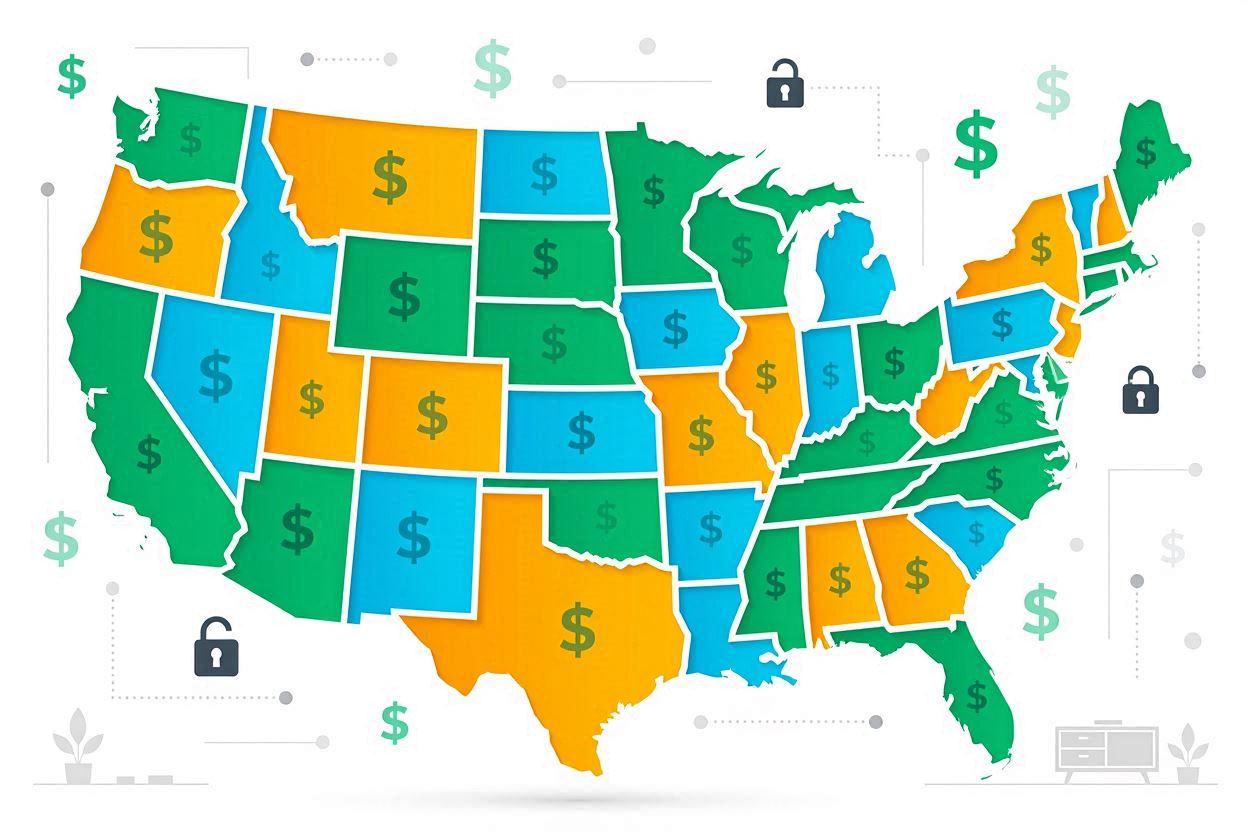
National median
$124,910
BLS OEWS May 2024
Top-paying state
Washington
$148,090 mean annual
Lowest-paying state
Mississippi
~$95,800 mean annual
90th percentile
$186,420
Top earners nationally
10th percentile
$69,660
Entry-level floor
Job growth 2024-34
+29%
Much faster than average
Jump to section
Where you live determines how much cybersecurity work pays you — sometimes by more than $50,000 per year for the same role. Washington's $148,090 average crushes Mississippi's $95,800 by 55%. But raw salary numbers lie. California's massive $140,730 mean becomes just $99,107 in real purchasing power once cost of living factors in. This guide gives you both numbers — nominal and adjusted — across all 50 states, verified against BLS OEWS May 2024 data, with realistic salary ranges by experience level and role.
Top 10 highest-paying states
Mean annual salaries for information security analysts (BLS occupation code 15-1212). Washington leads at $148,090, driven by Microsoft, Amazon, and Boeing concentration. Iowa surprises at #2 with $143,960 — exceptional for a state with below-average cost of living.
| Rank | State | Mean Annual | Jobs | COL Index |
|---|---|---|---|---|
| #1 | Washington | $148,090 | 6,890 | 116 |
| #2 | Iowa | $143,960 | 1,140 | 90 |
| #3 | New York | $140,770 | 11,520 | 126 |
| #4 | California | $140,730 | 20,420 | 142 |
| #5 | New Hampshire | $139,050 | 550 | 108 |
| #6 | Delaware | $134,560 | 780 | 104 |
| #7 | Maryland | $134,130 | 8,770 | 110 |
| #8 | Virginia | $133,520 | 21,930 | 103 |
| #9 | DC | $132,470 | 3,890 | 143 |
| #10 | New Jersey | $131,340 | 8,260 | 115 |
COL Index: 100 = national average. Above 100 = more expensive than US average. Source: BLS OEWS May 2024 + BEA Regional Price Parities 2023.
Washington — $148,090
Tech giants (Amazon, Microsoft) + Boeing defense
Iowa — $143,960
Hidden gem — high pay, low cost of living
New York — $140,770
Finance + media + government concentration
California — $140,730
Largest market, but cost wipes out premium
New Hampshire — $139,050
Boston commuter belt, lower state tax
Cost-adjusted top 10 (real purchasing power)
Nominal salary tells you the offer letter number. Cost-adjusted salary tells you what that number actually buys. When you factor in housing, food, healthcare, and taxes, the ranking changes dramatically. Iowa beats California — by a lot. Texas with no state income tax beats much of the West Coast in real take-home value.
| Rank | State | Adjusted | Nominal |
|---|---|---|---|
| #1 | Iowa | $159,956 | $143,960 |
| #2 | New Mexico | $140,940 | $130,070 |
| #3 | Alabama | $140,310 | $118,800 |
| #4 | Texas | $132,758 | $119,480 |
| #5 | Tennessee | $132,540 | $112,659 |
| #6 | Virginia | $129,631 | $133,520 |
| #7 | Washington | $127,664 | $148,090 |
| #8 | Georgia | $125,889 | $113,300 |
| #9 | Maryland | $121,936 | $134,130 |
| #10 | Ohio | $120,857 | $108,772 |
The hidden truth: California ranks #4 nominal but drops to #15 cost-adjusted. The $40K+ premium evaporates against housing costs in the Bay Area (median home: $1.4M) and Los Angeles ($870K). Meanwhile, Iowa's $143,960 nominal buys a $400K home in suburban Des Moines — same square footage as a $1.4M Bay Area house.
Lowest-paying states (but watch the COL)
Mississippi, Montana, and Arkansas rank lowest by raw salary numbers. But these states also have very low costs of living — sometimes 25–30% below the national average. Don't dismiss them outright if you're targeting remote work with a low-cost lifestyle.
| Rank | State | Mean Annual | Why It's Low |
|---|---|---|---|
| #1 | Mississippi | ~$95,800 | Limited tech sector, mostly government roles |
| #2 | Montana | ~$96,200 | Small market, few tech employers |
| #3 | Arkansas | ~$96,800 | Walmart HQ provides some demand |
| #4 | Vermont | ~$97,400 | Tiny market, mostly remote roles |
| #5 | Oklahoma | ~$98,100 | Energy sector security only |
| #6 | Indiana | ~$98,600 | Manufacturing-focused, limited specialization |
| #7 | West Virginia | ~$99,200 | Few tech employers |
| #8 | South Dakota | ~$100,100 | Some financial sector demand |
| #9 | Kentucky | ~$101,400 | Government + some financial roles |
| #10 | Louisiana | ~$102,800 | Energy + healthcare security |
Note: These are local market salaries. Remote work from these states for higher-paying employers can completely change the math.
Top 10 highest-paying metros
Within a state, metro area matters enormously. Silicon Valley ($175,520) exceeds the rest of California by $35K. DC metro ($148,900) crushes rural Virginia. If you're location-flexible within a state, target the right metro.
San Jose-Sunnyvale-Santa Clara, CA
Silicon Valley — highest in nation
San Francisco-Oakland-Berkeley, CA
Tech giants + fintech
Seattle-Tacoma-Bellevue, WA
Amazon, Microsoft headquarters
New York-Newark-Jersey City, NY-NJ
Wall Street + media + Fed Reserve
Washington-Arlington-Alexandria, DC-VA-MD
Federal cyber + Pentagon contractors
Los Angeles-Long Beach-Anaheim, CA
Entertainment + aerospace
Boston-Cambridge-Newton, MA
Universities + biotech + Defense
Austin-Round Rock-Georgetown, TX
Tech boom + Dell + Oracle
Denver-Aurora-Lakewood, CO
Tech hub + Lockheed + telecom
Chicago-Naperville-Elgin, IL
Finance + consulting concentration
Salary by experience level
Experience drives more salary growth than any other factor in cybersecurity. Entry to principal typically multiplies pay by 3–4x. State location adds 30–50% on top of that progression.
Entry-Level (0–2 years)
$70,000 – $95,000SOC Tier 1, Junior Security Analyst, Security Specialist roles. Most candidates need Security+ + hands-on lab work to land first role.
Top 5 states for this level
Mid-Level (3–5 years)
$95,000 – $130,000SOC Tier 2/3, Security Engineer, Vulnerability Analyst, Penetration Tester. Most candidates hold Security+ plus specialized cert (CySA+, eJPT, OSCP, AWS Security).
Top 5 states for this level
Senior (6–10 years)
$130,000 – $170,000Senior Engineer, Security Architect (junior), Threat Hunter, Lead Pentester. CISSP, OSCP, or specialized senior cert typically required.
Top 5 states for this level
Principal/Lead (10+ years)
$170,000 – $250,000+Principal Security Engineer, Security Architect, CISO direct reports. CISSP, CISM, or executive cert + significant leadership experience.
Top 5 states for this level
Salary by role type
Within cybersecurity, role specialization shifts pay significantly. SOC Tier 1 sits at the bottom; Security Architects and CISOs sit at the top. Cloud security commands premiums across all levels in 2026.
| Role | Entry | Senior |
|---|---|---|
| SOC Analyst (Tier 1) Entry point for most cybersecurity careers | $60,000–$78,000 | $95,000–$130,000 |
| SOC Analyst (Tier 2/3) Investigates escalated incidents | $85,000–$110,000 | $120,000–$165,000 |
| Information Security Analyst BLS official category, broad role | $70,000–$95,000 | $130,000–$180,000 |
| Penetration Tester OSCP/eJPT-track, offensive security | $75,000–$100,000 | $140,000–$200,000 |
| Security Engineer Builds and maintains security infrastructure | $85,000–$115,000 | $150,000–$200,000 |
| Cloud Security Engineer AWS/Azure/GCP specialization premium | $95,000–$125,000 | $160,000–$220,000 |
| Security Architect Senior role, designs security frameworks | $120,000–$150,000 | $180,000–$260,000 |
| CISO / Security Director Executive role, requires extensive experience | $160,000–$200,000 | $250,000–$500,000+ |
6 salary negotiation tactics that actually work
State and metro data is the starting point. These tactics use that data to get you 15–25% more than the initial offer.
Research the metro, not just the state
Pay varies enormously within a state. Austin pays $35K+ more than rural Texas. Silicon Valley exceeds the rest of California by $40K+. Look up your specific metro area's BLS data, not just the state average. The metro number is what hiring managers benchmark against.
Use remote work as leverage (carefully)
Roughly 70% of cybersecurity roles offer remote/hybrid options in 2026. Companies pay regional rates — but you can sometimes negotiate the higher metro rate while living in a cheaper area. The 'work from Texas, paid like SF' play works at smaller companies; FAANG-tier employers usually adjust pay to your location.
Add the certification premium
Security+ alone adds 10–15% to base offers. CISSP adds 20–25%. Cloud certs (AWS Security Specialty, Azure SC-100) add 15–20%. Specialized certs (OSCP, GIAC) add 25–30% in offensive/IR roles. Document your certs in offer negotiations — they're hard salary anchors employers respect.
Compare total comp, not just salary
FAANG-tier employers structure compensation as base + equity + bonus. Total comp at Amazon Seattle ($200K+) for senior engineer often beats base salary at smaller companies in higher-paying states. When comparing offers, demand the full breakdown: base, signing bonus, RSU vesting schedule, annual bonus target, retirement match.
Leverage clearance for federal contractor roles
Active security clearance adds $15,000–$30,000+ to baseline salary in DC/Virginia/Maryland markets. Top Secret with SCI access commands the highest premium. If you have or can obtain clearance, your earning ceiling in those metros jumps dramatically. Federal contractors will pay more than commercial employers for cleared candidates.
Time your move strategically
Salaries typically increase 8–15% with each job change in cybersecurity. Staying 4+ years at one employer often costs $20K–$40K in foregone earnings vs strategic moves every 18–24 months. Loyalty rarely beats market timing — but don't job-hop aggressively until you have 2–3 years of solid experience first.
The honest verdict
Cybersecurity pays well in every state — even the lowest-paying state (Mississippi at ~$95,800) crushes the national median for all occupations ($49,500) by nearly 2x. But the real winners aren't always in the headline-grabbing markets.
The hidden gem is Iowa: $143,960 mean salary with the cost of living 10% below the national average. That's $159,956 in adjusted purchasing power — beating California, Washington, and New York after housing costs settle. The same pattern applies to New Mexico, Alabama, Texas, and Tennessee. Smart cybersecurity professionals optimize for adjusted income, not nominal.
My recommendation: Don't move to the Bay Area for a $40K nominal raise that becomes negative purchasing power. Target your top 3 metros by cost-adjusted income, lock in remote work where possible, and negotiate the metro-level rate even if you don't live in the metro. That's how cybersecurity professionals build wealth, not just income.
Frequently asked questions
The most common questions about cybersecurity salaries by state.
01 Which US state pays cybersecurity professionals the most in 2026?
02 What is the cybersecurity salary in California vs Texas?
03 How much does an entry-level cybersecurity analyst make by state?
04 What states have the most cybersecurity jobs?
05 Do cybersecurity salaries adjust for cost of living when adjusted?
06 How does remote work affect cybersecurity salaries by state?
07 What's the difference between BLS data and Glassdoor/Levels.fyi numbers?
08 Which cybersecurity certification increases salary the most?
Calculate your cybersecurity salary potential
Use our Salary Calculator to estimate your earning potential based on experience, certifications, and location — across 27 US cities.
Open the Salary CalculatorRelated guides
Hand-picked next reads from CertCompass.
Cybersecurity Salary Guide 2026
Comprehensive salary data by role, experience level, and certification — not just geography.
Entry-Level Cybersecurity Jobs 2026
6 realistic roles you can land in 6-12 months with salary data and required skills.
Best Cybersecurity Certifications for Beginners 2026
Honest comparison of 10 entry-level certs ranked by ROI, difficulty, and career fit.